
WHY IT MATTERS FOR WORKPLACE SAFTEY IN INDIA
- For a long time, India did not have any specific law or legal framework to address sexual harassment at the workplace.
- here was no dedicated statutory framework laying down a clear mechanism for the prevention, prohibition and redressal of workplace sexual harassment. Women facing such situations had to rely largely on existing legal provisions, which did not specifically address the unique nature of sexual harassment at the workplace.
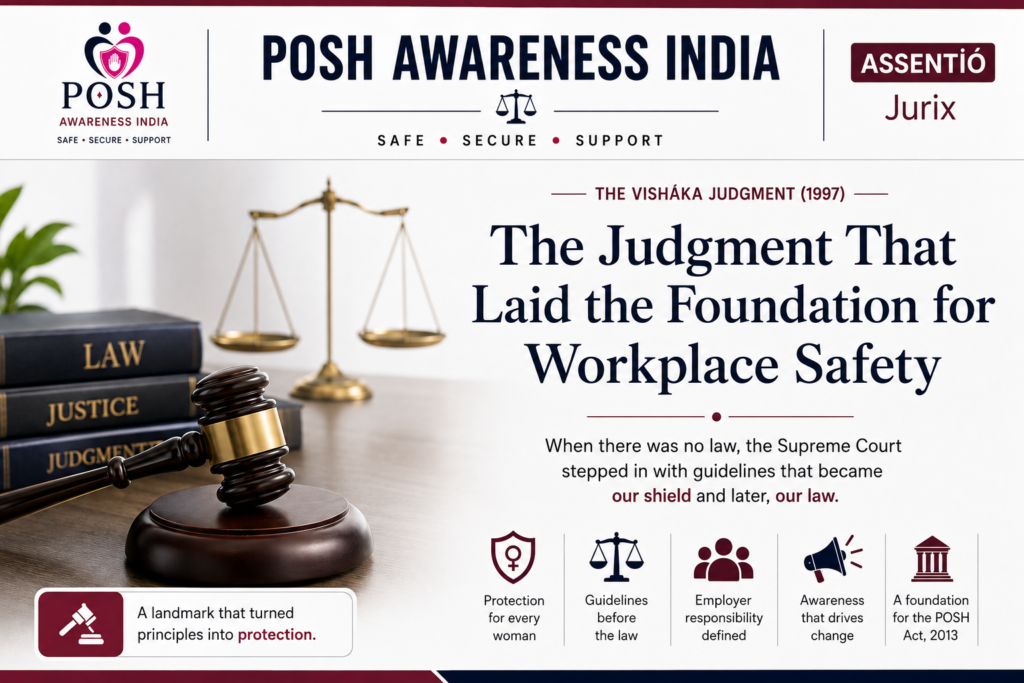
This major legal gap was finally addressed by the Supreme Court in the landmark Vishaka case (1997), which became a turning point in the history of workplace safety in India.
THE CASE THAT CHANGED EVERYTHING:-
- Bhanwari Devi was a social worker in Rajasthan under a government programme aimed at preventing child marriage
- She attempted to prevent a child marriage in her village
- As retaliation, she was sexually assaulted by a group of men from the village.
- The handling of her case exposed serious shortcomings in the legal and institutional protection available to women at that time.
- The incident highlighted a much larger problem: there was no specific legal framework dealing with sexual harassment of women at the workplace.
- It also demonstrated that women working in field-based and informal work environments could be particularly vulnerable and required effective legal protection.
This incident ultimately became the background to the Vishaka proceedings before the Supreme Court.
WHY THE CASE IS CALLED “VISHAKA”
- The incident involved Bhanwari Devi, but the case name is Vishaka & Ors. v. State of Rajasthan & Ors.
- The petition was filed by a group of women’s rights organisations under the name “Vishaka”
- These organisations approached the Supreme Court seeking:
- Recognition of sexual harassment as a violation of fundamental rights
- A legal framework for workplace protection
- Since the petition was filed under this collective name, the judgment became known as the Vishaka case
- The guidelines issued by the Court are therefore called the Vishaka Guidelines
THE BIRTH OF THE VISHAKA GUIDELINES:-
- At the time, India did not have a specific legislation providing a comprehensive mechanism for dealing with sexual harassment at the workplace.
- The Supreme Court stepped in and created binding guidelines
- These guidelines acted as a temporary legal framework until Parliament passed a law
The guidelines required employers to take proactive steps, including:
- Preventing sexual harassment at the workplace
- Setting up a formal complaint mechanism
- Establishing an Internal Complaints Committee with fair representation, including a woman member and an external member
- Ensuring confidentiality during the complaint process
- Conducting regular awareness and training programs
- Taking appropriate disciplinary action against offenders
RECOGNISING WORKPLACE SAFETY AS A RIGHT:-
One of the most important contributions of the judgement was its clear recognition that a safe workplace is not a privilege—it is a fundamental right. The Court supported this view through constitutional provisions as well as international conventions that promote gender equality and workplace safety.
A FOUNDATION FOR FUTURE LAW:-
- The Vishaka Guidelines remained the only legal framework for 16 years
- They shaped how organisations handled harassment complaints
- They Increased awareness regarding women’s rights at the workplace
- Influenced the development of a comprehensive statutory framework for workplace sexual harassment
- Ultimately paved the way for the Sexual Harassment of Women at Workplace (Prevention, Prohibition and Redressal) Act, 2013
CONCLUSION:-
- The Vishaka judgment of 1997 remains a landmark in Indian legal history.
- It filled a major legal vacuum in workplace safety
- It transformed workplace harassment from a “private issue” to a legal and constitutional issue
- It laid the foundation for the POSH Act, 2013
Key Takeaway: The POSH Act did not create workplace safety laws from scratch—it gave legal force to the Vishaka Guidelines, which were introduced because no specific law or jurisdiction existed at the time to address workplace sexual harassment.
Vishaka was not merely a judgment. It was the beginning of a legal framework that changed how India understood safety, dignity and equality at the workplace.