
“If it really happened, why didn’t they report it immediately?”
This is one of the most common—and most misunderstood—questions asked whenever a workplace sexual harassment complaint surfaces after weeks, months, or even years.
The assumption that a person experiencing sexual harassment will report the incident immediately overlooks an important reality: people can respond to distressing or unwanted experiences in very different ways. Reporting workplace sexual harassment is not simply a legal decision; it is an emotional, psychological, professional, and social one.
The POSH Act, 2013 provides a framework for addressing workplace sexual harassment, but understanding why many individuals hesitate to come forward is equally important. Delay in reporting, by itself, should not automatically be treated as proof that a complaint is false or unreliable. The reasons for the delay should be considered in the context of the circumstances of each case.
Fear of Not Being Believed
One of the strongest barriers to reporting is fear.
Many individuals worry that their experience will be questioned or dismissed. They fear being asked why they did not object immediately, why there were no witnesses, or why they continued interacting with the respondent after the incident.
In workplaces where the alleged harasser holds a senior position or enjoys significant influence, this fear becomes even greater. Complainants often believe that their word will carry less weight than that of someone in authority.
Rather than risking disbelief, many choose silence.
Shame and Self-Blame
A person experiencing sexual harassment may question themselves instead of questioning the wrongdoer.
They may replay the incident repeatedly, wondering whether they misunderstood the situation, whether they somehow encouraged the behaviour, or whether speaking up will lead others to judge them.
Where conduct is established as sexual harassment, responsibility rests with the person who engaged in the unwelcome conduct. However, feelings of shame may prevent a complainant from seeking help. The emotional burden becomes heavier when complainant fear that colleagues will gossip about the incident or define them solely by their complaint.
Career Concerns
For many employees, reporting sexual harassment feels like risking their livelihood.
They may fear:
- Losing promotion opportunities.
- Receiving poor performance evaluations.
- Being excluded from important projects.
- Damaging professional relationships.
- Being labelled as “difficult” or “problematic.”
- Losing their job altogether.
These concerns become particularly significant when the alleged harasser is a reporting manager, senior executive, founder, or someone with substantial influence over workplace decisions.
As a result, many employees choose to tolerate unacceptable behaviour rather than jeopardise years of professional growth.
Social Pressure
Workplaces are social environments where professional relationships matter.
Employees may face subtle or direct pressure from colleagues, friends, or even family members to remain silent.
Comments such as:
“Don’t create unnecessary trouble.”
“Think about your career.”
“Everyone knows that’s just how they behave.”
“It will become office gossip.”
can discourage someone from reporting misconduct.
The pressure to maintain workplace harmony often outweighs the desire to seek justice.
The Fear of Retaliation
Even when organisations have a POSH policy and an Internal Committee in place, employees may fear indirect retaliation.
Retaliatory behaviour may not always be obvious. Depending on the circumstances, it may include:
- Exclusion from meetings.
- Isolation by colleagues.
- Negative workplace behaviour.
- Reduced responsibilities.
- Unfavourable transfers.
- Professional isolation.
The anticipation of these consequences can discourage individuals from making a complaint.
Why Organisations Must Understand This Reality
A workplace that asks, “Why didn’t you report earlier?” may unintentionally discourage future complaints.
A better question is:
“What prevented you from feeling safe enough to report sooner?”
Creating a psychologically safe workplace requires more than legal compliance. It requires trust, confidentiality, empathy, and confidence that complaints will be handled fairly and without retaliation.
When employees believe they will be heard rather than judged, they may feel more confident in raising concerns at an early stage.
Building a Culture Where People Feel Safe to Speak Up
Organisations can reduce barriers to reporting by:
- Conducting regular POSH awareness and sensitisation programmes.
- Ensuring employees understand the complaint mechanism.
- Promoting confidentiality throughout the inquiry process.
- Training managers to respond sensitively to concerns.
- Clearly communicating that retaliation will not be tolerated.
- Demonstrating that every complaint will be assessed fairly and impartially.
A workplace culture built on trust encourages early reporting, protects employees, and strengthens organisational integrity.
Conclusion
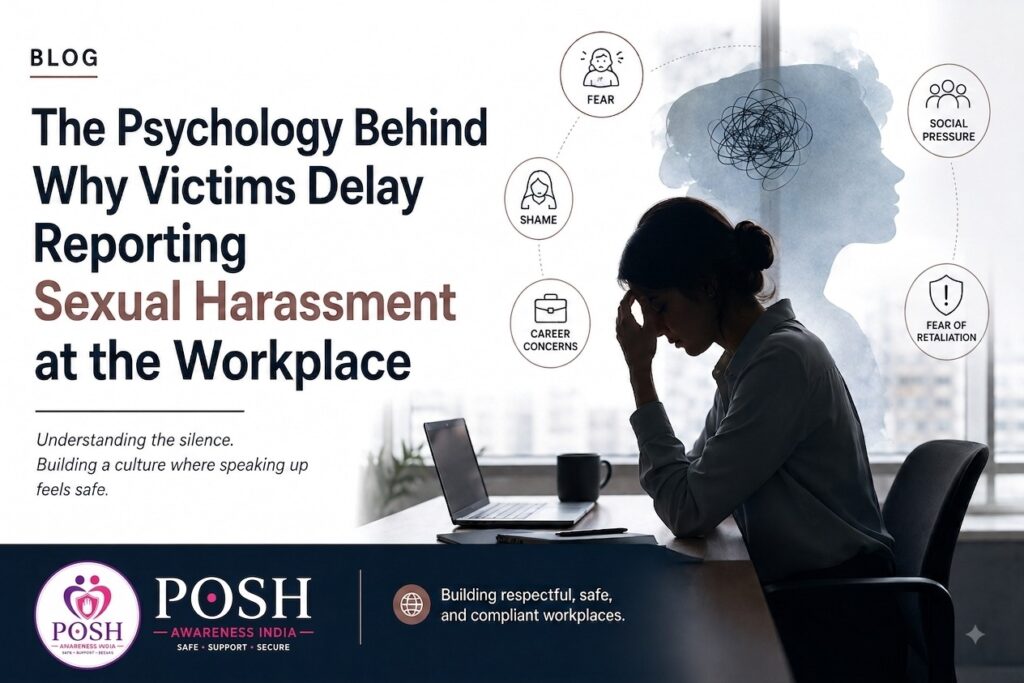
Delayed reporting should never be viewed in isolation. Fear, shame, career concerns, social pressure, and the emotional and psychological impact of the experience can all influence when and how a person decides to speak up.
The POSH framework is not limited to addressing complaints after they arise; prevention, awareness and an effective mechanism for redressal are essential to creating a workplace where employees feel safe to raise concerns without fear of judgement or retaliation. A truly respectful workplace is not measured by the number of complaints it receives, but by the confidence employees have that, if something goes wrong, they will be heard, treated fairly, and protected throughout the process.