
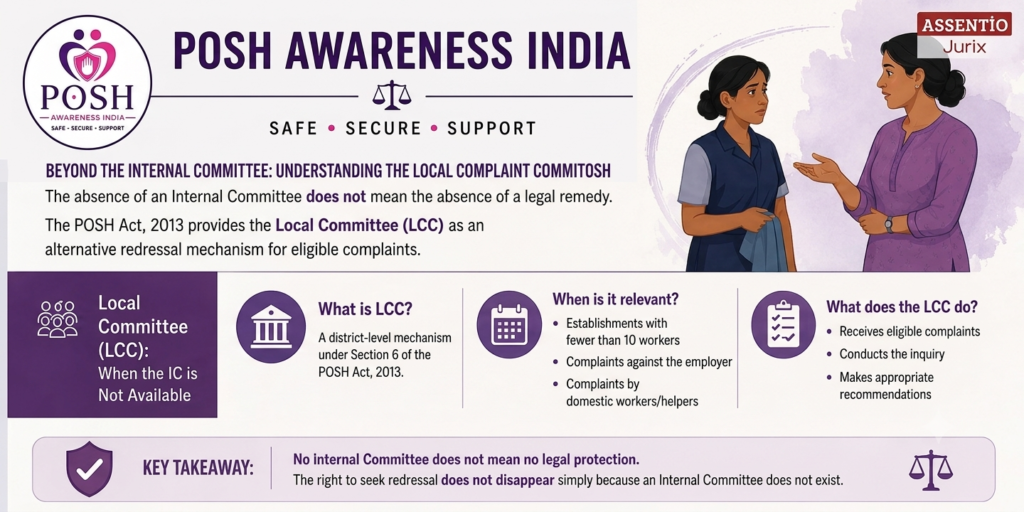
It was an ordinary evening when Meera, a domestic worker, was asked to stay back after work. During her employment, her employer made sexually coloured remarks and attempted unwelcome physical contact.
Distressed, Meera wanted to report the incident—but there was no HR department, Internal Committee, or formal grievance mechanism at the household.
For women working outside conventional workplaces, the absence of an Internal Committee can make it seem as though there is no legal remedy.
LOCAL COMMITTEE (LCC): WHEN THE INTERNAL COMMITTEE IS NOT CONSTITUTED
The absence of an Internal Committee does not mean the absence of a legal remedy.
The Sexual Harassment of Women at Workplace (Prevention, Prohibition and Redressal) Act, 2013 provides for a Local Committee (LCC) at the district level to deal with complaints in specified circumstances. Section 6 provides for its constitution by the District Officer.
What is the Local Committee?
The Local Committee (LCC) is a district-level statutory mechanism constituted under Section 6 of the POSH Act, 2013.
When is the LCC relevant?
The LCC is relevant, among other cases, where:
- The establishment has less than 10 workers and therefore an Internal Committee has not been constituted; or
- The complaint is against the employer himself.
The POSH Act also specifically recognises domestic workers and provides for the application of the statutory framework to complaints arising in relation to a dwelling place or house.
What does the LCC do?
The Local Committee is empowered to:
- Receive eligible complaints of sexual harassment;
- Deal with and inquire into complaints in accordance with the procedure prescribed under the Act; and
- Make appropriate recommendations in accordance with the statutory framework.
The Act also provides for nodal officers in specified areas to receive complaints and forward them to the concerned Local Committee.
KEY TAKEAWAY
No Internal Committee does not mean no legal protection.
The POSH Act provides a Local Committee (LCC) as a statutory mechanism for eligible complaints where an Internal Committee is not constituted because the establishment has fewer than ten workers, or where the complaint is against the employer.
The Act also specifically recognises domestic workers and extends the concept of workplace to include a dwelling place or house.
The right to seek redressal does not disappear simply because an Internal Committee does not exist.