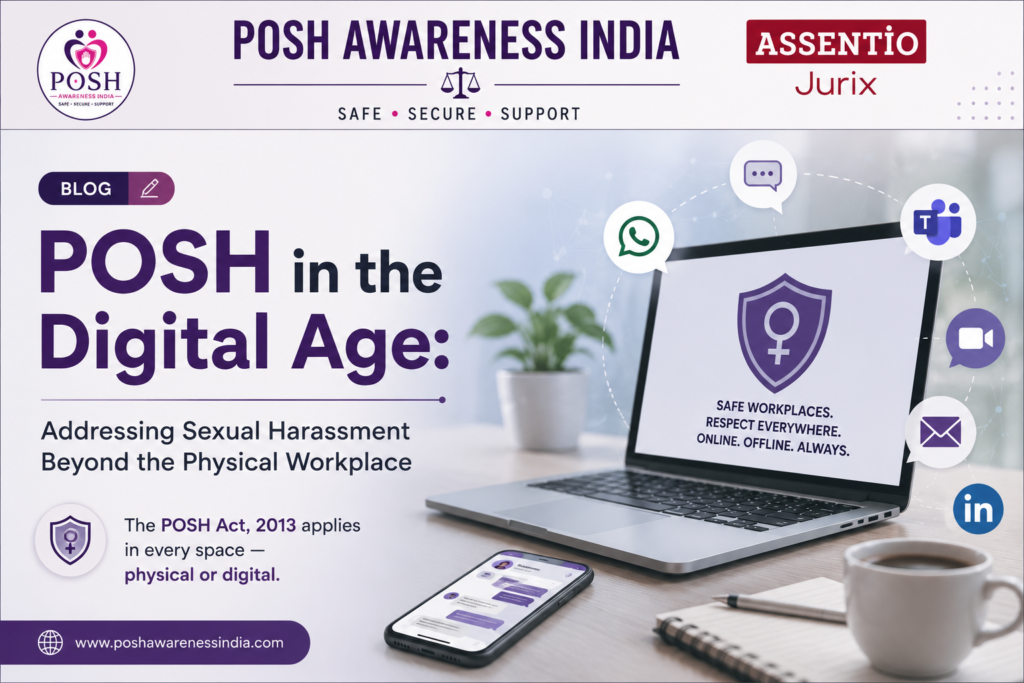
The Digital Workplace and the POSH Act: Addressing Sexual Harassment Through Online Platforms, Messaging Applications and Artificial Intelligence
— By POSH Awareness India
THE DIGITAL WORKPLACE
Modern workplaces are no longer limited to physical office premises.
Emails, WhatsApp, Microsoft Teams, Zoom, Slack and other digital platforms have become an integral part of professional communication. Remote and hybrid working arrangements have further expanded the ways in which employees interact with one another.
As a result, workplace-related misconduct may arise not only in physical spaces but also through digital interactions connected with employment.
The need for dignity, respect and safety therefore extends to the digital dimensions of the workplace.
THE EXPANDING MEANING OF THE WORKPLACE
The POSH Act, 2013 contains a broad definition of “workplace” under Section 2(o), which extends beyond a traditional office and includes places visited by an employee arising out of or during the course of employment, as well as transportation provided by the employer.
In the context of modern working arrangements, certain digital interactions may also have a sufficient connection with the workplace or employment.
Professional communication may take place through:
- Emails
- Microsoft Teams
- Zoom
- Slack
- Professional social media platforms
- Other work-related digital platforms
Interactions involving employees, colleagues, clients, customers, vendors or other persons connected with work may, depending on the circumstances, have a workplace connection.
However, not every online interaction automatically falls within the POSH framework. The nature of the conduct, the relationship between the individuals, the circumstances in which it occurred and its connection with employment are important considerations.
DIGITAL COMMUNICATION AS A MEDIUM OF SEXUAL HARASSMENT
Sexual harassment is not limited to physical contact.
Unwelcome conduct may also be communicated through digital means. Depending on the circumstances, examples may include:
- Repeated unwanted messages of a sexual nature
- Unwelcome sexual advances through messaging platforms
- Inappropriate sexual comments in work-related group chats
- Sharing sexually explicit or inappropriate material
- Sexual jokes or remarks
- Inappropriate private messages connected with work
- Misuse of virtual meeting platforms for inappropriate conduct
- Persistent unwanted contact through professional social media
The fact that the conduct occurs through a screen does not, by itself, determine whether it falls within the POSH framework.
The nature of the conduct and its connection with the workplace or employment must be considered.
DIGITAL MISCONDUCT AND ARTIFICIAL INTELLIGENCE
Artificial Intelligence has introduced new forms of digital manipulation and misuse.
Technology can potentially be misused to create or alter:
- Deepfake images
- AI-generated videos
- Synthetic or cloned voices
- Manipulated conversations
- Fabricated or altered digital content
Such content may cause emotional distress, reputational harm, privacy concerns and workplace disruption.
Where AI-generated or manipulated content involves conduct of a sexual nature and has a sufficient connection with the workplace, it may raise issues under the POSH framework, depending on the facts and circumstances of the case.
However, the fact that content is AI-generated does not automatically make it a POSH violation. The nature of the conduct, the persons involved, the circumstances in which the content was created, shared or used, and its connection with the workplace must be examined.
Organisations and Internal Committees should therefore remain alert to emerging forms of technology-related misconduct.
DIGITAL EVIDENCE IN POSH PROCEEDINGS
Digital interactions may leave behind important evidence, including:
- Emails
- Chat messages
- Screenshots
- Digital files
- Audio or video recordings
- Relevant metadata
- Other electronic records
Such material may assist the Internal Committee in understanding the facts and circumstances of a complaint.
At the same time, digital evidence may raise questions relating to:
- Authenticity
- Manipulation
- Context
- Privacy
- Completeness
- Preservation of evidence
Accordingly, relevant digital material should be handled carefully, with appropriate attention to collection, preservation, confidentiality and verification.
Where the authenticity or technical nature of digital evidence is disputed, appropriate technical assistance may be considered.
EMPLOYER RESPONSIBILITY IN THE DIGITAL ERA
Employers should consider digital workplace risks as part of their broader POSH awareness and prevention framework.
They should:
- Establish clear expectations regarding appropriate online workplace behaviour.
- Include digital communication and remote-working scenarios in POSH awareness programmes.
- Train employees on respectful and professional online conduct.
- Create awareness regarding inappropriate digital interactions.
- Inform employees about available reporting mechanisms.
- Encourage timely reporting of workplace-related concerns.
- Equip Internal Committee members to understand and appropriately assess digital evidence.
- Maintain confidentiality while dealing with complaints involving sensitive digital material.
- Take technology-related complaints seriously and deal with them in accordance with applicable law and organisational policy.
CONCLUSION
The workplace has evolved into a digital ecosystem, but the need for dignity and respect remains unchanged.
The POSH Act, 2013 provides a broad statutory framework for addressing sexual harassment in the workplace. In the context of digital and remote working, conduct occurring through electronic communication may require consideration where it has a sufficient connection with the workplace or employment.
Whether the conduct occurs through emails, chats, virtual meetings, professional social media or technology-enabled content, the circumstances of each case must be carefully examined.
As technology continues to evolve, organisations must evolve with it—strengthening POSH awareness, protecting confidentiality, understanding emerging digital risks and fostering a culture where respect extends beyond the physical office into every work-related interaction.
A safe workplace today must also be a safe digital workplace.