
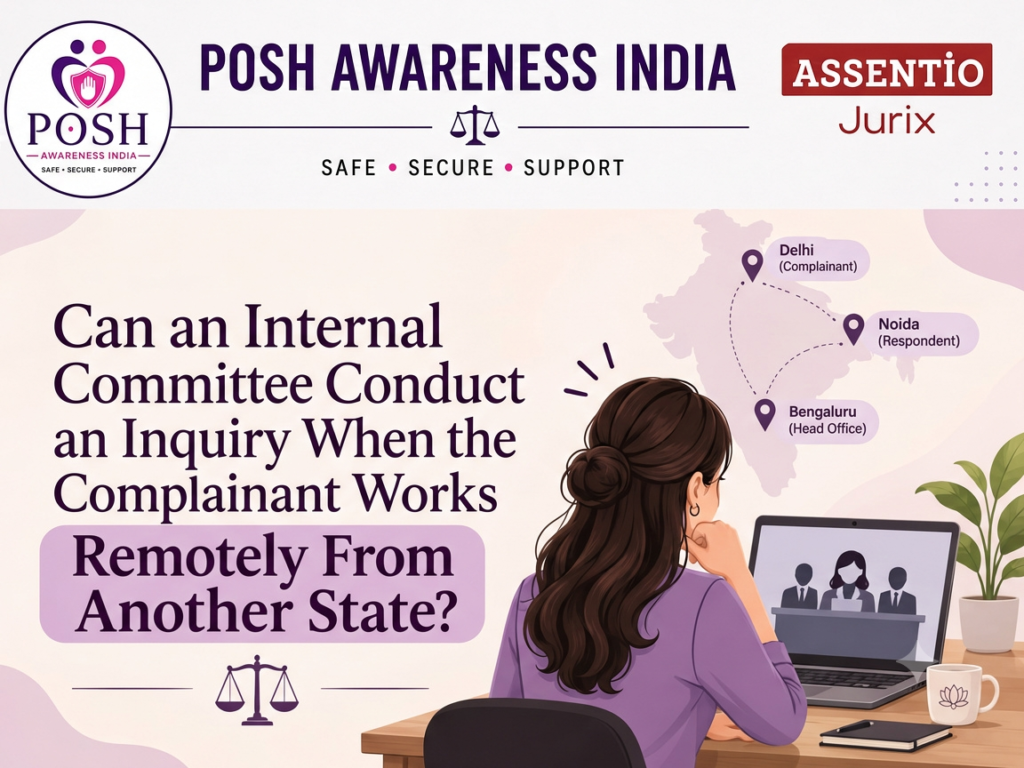
Does remote working affect the jurisdiction of the Internal Committee under the POSH Act, 2013?
An employee works from Delhi, the respondent is based in Noida, and the organisation’s headquarters are in Bengaluru. If a POSH complaint is filed, which Internal Committee should handle the inquiry?
With remote and hybrid working becoming increasingly common, organisations often have employees working across different cities and states. This raises an important question: Does an employee’s remote working location affect the jurisdiction of the Internal Committee?
The answer requires examining the nature of the workplace, the organisation’s structure and the circumstances surrounding the complaint.
1. Does Working From Another State Change the IC’s Jurisdiction?
Not automatically.
The POSH Act, 2013 does not provide that an employee’s change of state or remote working location automatically transfers a complaint to another Internal Committee.
Section 4 requires employers to constitute an Internal Committee. Its proviso specifically addresses workplaces having offices or administrative units at different places or at divisional or sub-divisional levels, requiring an IC at such offices or administrative units.
Therefore, an organisation must examine its actual establishment and administrative structure rather than relying only on the employee’s current residential location.
2. Can the Existing Internal Committee Conduct the Inquiry?
Yes, where it is the appropriate committee for the relevant workplace or administrative unit.
For example:
- The organisation has its headquarters in Noida.
- An employee works remotely from Jaipur.
- The respondent is based in Noida.
- The organisation has an IC constituted for the relevant establishment.
The employee’s remote location in Jaipur does not, by itself, make the existing IC ineligible to examine the complaint.
However, if the organisation has a separate office or administrative unit in Jaipur, the requirement under Section 4 must also be examined.
3. Can the Inquiry Be Conducted Through Video Conferencing?
This is another important practical consideration.
The POSH Act and Rules do not expressly prescribe a comprehensive procedure for conducting inquiries through video conferencing.
However, Rule 7(4) of the POSH Rules requires the IC to conduct the inquiry in accordance with the principles of natural justice.
Virtual participation may be considered as a practical arrangement, provided the procedure protects fairness, confidentiality and gives both parties a meaningful opportunity to participate.
For this purpose, the Committee should consider:
- Providing advance notice of virtual hearings.
- Ensuring both parties can present their statements and responses.
- Maintaining confidentiality during online proceedings.
- Sharing relevant documents and supporting material appropriately.
- Maintaining proper records of the proceedings.
- Ensuring the required minimum three Committee members, including the Presiding Officer, participate in the inquiry, as required under Rule 7(6).
A virtual hearing should not compromise either party’s opportunity to present their case.
4. What Is HR’s Responsibility in Such Cases?
HR plays an important administrative and facilitative role.
HR should:
- Identify the appropriate Internal Committee based on the organisation’s structure.
- Coordinate with the Committee regarding the complainant’s remote working arrangement.
- Facilitate virtual participation wherever appropriate.
- Arrange access to relevant documents and workplace records.
- Provide the necessary facilities to the Committee for conducting the inquiry.
- Avoid influencing the Committee’s independent assessment or findings.
HR must remember that facilitating an inquiry and deciding its outcome are two different responsibilities.
5. What Does the POSH Act Say About the Timeline?
Section 11(4) of the POSH Act provides that an inquiry must be completed within 90 days.
An employee working remotely or residing in another state should not, merely because of that arrangement, be placed at a procedural disadvantage.
The organisation and the Committee should make reasonable administrative arrangements so that geographical distance does not unnecessarily delay the proceedings.
Key Legal Takeaways
- Remote working from another state does not automatically change the jurisdiction of an Internal Committee.
- Section 4 requires ICs at different offices or administrative units, where applicable.
- Virtual participation may be considered, subject to procedural fairness and natural justice.
- HR should facilitate the inquiry without interfering with the Committee’s independence.
- The inquiry must be completed within the statutory timeline of 90 days.
Conclusion
Remote working has changed the way organisations operate, but it has not removed their responsibility to maintain an effective POSH redressal mechanism.
An employee should not have to face unnecessary geographical difficulties while participating in an inquiry.
The objective should remain the same: a fair, confidential and accessible inquiry, irrespective of where the employee is working from.
Legal reference: Sections 4 and 11 of the Sexual Harassment of Women at Workplace (Prevention, Prohibition and Redressal) Act, 2013, read with Rule 7 of the POSH Rules, 2013.Disclaimer: This article is intended for general awareness and does not constitute legal