
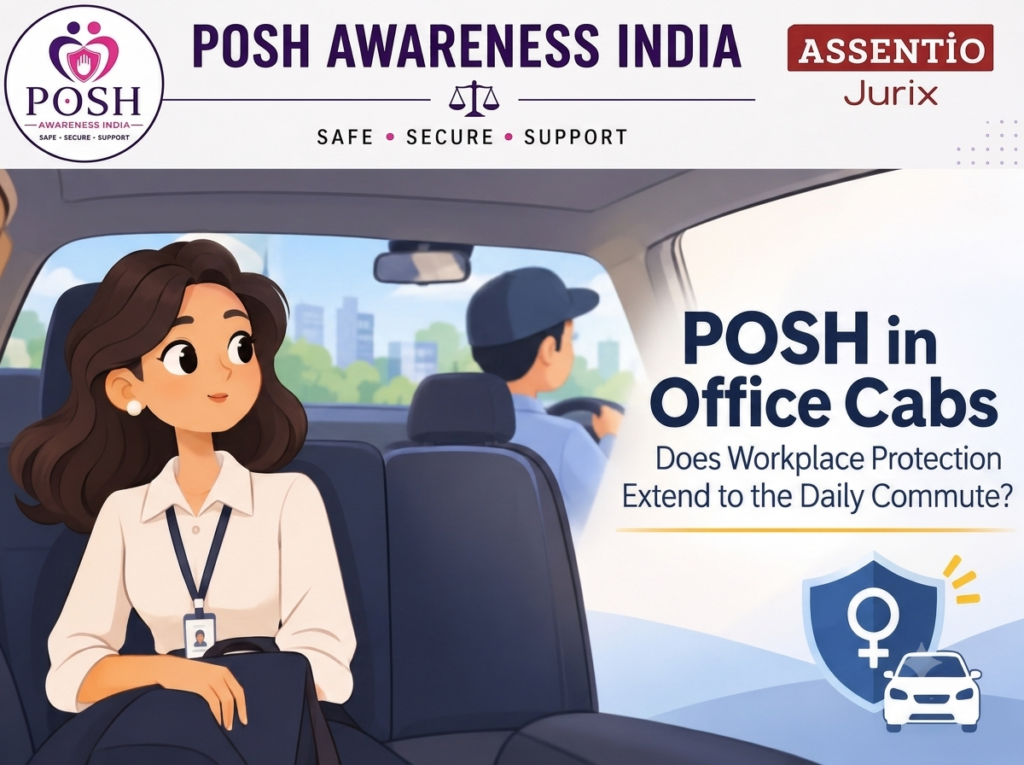
Does workplace safety end when an employee leaves the office, or does it extend to the journey back home?
For many employees, travelling in an organisation-provided cab is part of their daily work routine. But what happens when an employee experiences sexual harassment during this journey?
Can such an incident fall under the POSH Act, 2013? Does it matter if the alleged harasser is a colleague, cab driver or another co-passenger?
Let’s understand.
1. Does an Office Cab Qualify as a Workplace?
Yes. Section 2(o)(v) of the POSH Act specifically includes transportation provided by an employer for undertaking a journey arising out of or during the course of employment.
Therefore, workplace protection is not limited to office premises. An employer-provided cab may also form part of the workplace under the Act.
2. What Behaviour in an Office Cab May Amount to Sexual Harassment?
Sexual harassment does not necessarily involve physical contact. It may include:
- Sexually coloured remarks by a fellow employee.
- Inappropriate comments by a cab driver about an employee’s appearance.
- Unwelcome physical advances or touching.
- Sexually suggestive gestures or other unwelcome non-verbal conduct of a sexual nature.
Whether the conduct amounts to sexual harassment depends on the nature of the alleged behaviour and the facts and circumstances under Section 2(n) of the Act.
3. Who Is Responsible If the Harasser Is a Cab Driver?
Consider a situation where a woman employee experiences sexual harassment from a driver employed by an external transport vendor.
The fact that the driver is not directly employed by the organisation does not automatically exclude the incident from the POSH framework.
The complaint may be dealt with through the appropriate statutory mechanism. Where the respondent is not an employee of the organisation, Section 11(1)(b) provides for the Internal Committee to conduct the inquiry and, where the allegation is proved, recommend appropriate action under applicable law.
The organisation should also take appropriate steps within its control, including coordinating with the transport vendor and addressing safety concerns.
4. What Should Employers Do?
Organisations should treat employee transportation as an important part of workplace safety.
Some preventive measures include:
- Establishing clear conduct guidelines for drivers and employees.
- Conducting POSH awareness and sensitisation programmes.
- Including appropriate safety requirements in vendor agreements.
- Providing employees with accessible complaint-reporting channels.
- Taking prompt action when an incident is reported.
5. What If an Employee Uses a Personally Arranged Cab?
Section 2(o)(v) specifically covers transportation provided by the employer.
A privately arranged cab does not automatically qualify as an extended workplace merely because an employee is travelling to or from work. Its connection with employment and the surrounding circumstances must be examined.
Key Takeaways
- Workplace protection is not restricted to office premises.
- Employer-provided transportation is expressly covered under Section 2(o)(v).
- Sexual harassment inside an office cab may fall under the POSH Act.
- Third-party drivers and transport vendors should also be considered in workplace safety policies.
- Employers should ensure employees have a clear mechanism to report such incidents.
Conclusion
An office cab is more than just a means of transportation. When an organisation provides transportation to its employees, the journey may also form part of the workplace under the POSH Act.
Because workplace safety should not end when an employee leaves the office.
Relevant legal provisions: Sections 2(n), 2(o)(v), 9, 11(1)(b) and 19(a), 19(h) of the POSH Act, 2013.
Disclaimer: This article is intended for general awareness and informational purposes and should not be treated as legal advice.