
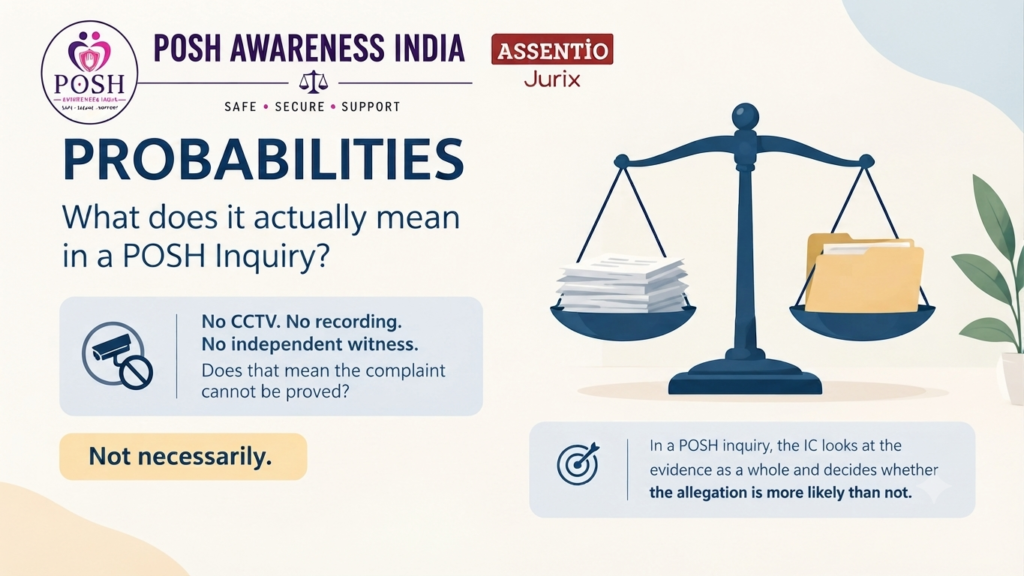
When there is no CCTV, recording or independent witness, how does an Internal Committee decide what happened?
In a POSH inquiry, one question often creates confusion:
“If there is no CCTV, no recording and no independent witness, how can the IC decide what happened?”
The answer lies partly in the standard of proof applicable to an internal inquiry.
A POSH inquiry is not a criminal trial. The Internal Committee (IC) does not determine criminal guilt or apply the criminal standard of proof beyond reasonable doubt.
In internal disciplinary proceedings, findings are generally assessed on the balance of probabilities.
What Does “Balance of Probabilities” Mean?
Simply put:
Which version of events is more likely to have occurred, based on the evidence available?
The IC may consider the complaint, response of the respondent, witness statements, messages, emails, documents, surrounding circumstances and other relevant material placed before it.
The question is whether, after considering the evidence as a whole, the alleged conduct is more likely than not to have occurred.
An Example
Suppose an employee alleges that a colleague repeatedly made inappropriate comments during one-on-one meetings.
There is no recording of those conversations.
The respondent denies making the comments.
However, during the inquiry, the IC finds that:
- The complainant’s account is substantially consistent.
- Certain emails or messages support the surrounding circumstances.
- A colleague observed the complainant’s reaction immediately after one of the meetings.
- There are material inconsistencies in the respondent’s explanation.
The absence of a recording does not automatically end the inquiry.
The IC must consider the entire body of evidence and determine which version is more probable.
That is the practical idea behind the balance of probabilities.
Does “No Direct Evidence” Mean the Complaint Fails?
Not necessarily.
Workplace incidents may sometimes occur privately, without witnesses or recordings.
That does not mean the IC should automatically accept the allegation.
Nor does it mean the allegation should automatically be rejected.
Instead, the IC should assess the available evidence and surrounding circumstances carefully.
Depending on the facts, circumstantial evidence may also be relevant.
Does Balance of Probabilities Mean the Complainant Is Automatically Believed?
No.
Balance of probabilities does not mean:
“Believe the complainant.”
It also does not mean:
“Believe the respondent unless there is direct proof.”
The IC is required to conduct a fair inquiry and provide both parties an opportunity to present their respective cases.
The finding should be based on the evidence and circumstances, not assumptions about either party.
What Can an IC Consider?
Depending on the facts of the case, the IC may consider:
- Consistency of statements;
- Emails, chats and other communications;
- Witness accounts;
- Relevant conduct before and after the incident;
- Documentary or digital evidence;
- Material contradictions;
- The circumstances surrounding the alleged incident; and
- Any other relevant material placed before the IC.
Importantly, one piece of evidence does not necessarily decide the case.
The evidence must be considered as a whole.
Balance of Probabilities Is Not Guesswork
This distinction is important.
The IC is not expected to say:
“We cannot know exactly what happened, so we will simply choose one version.”
A finding must have a reasonable basis in the material available during the inquiry.
The question is not:
“Can this allegation be proved with 100% certainty?”
The question is:
“On the evidence before the IC, is the alleged conduct more likely than not to have occurred?”
The Takeaway
The balance of probabilities recognises a practical reality of workplace inquiries:
Not every incident will have perfect or direct evidence.
But the absence of perfect evidence does not remove the need for a fair and careful inquiry.
An effective POSH inquiry requires the Internal Committee to:
Listen carefully. Examine the evidence. Consider both versions. Avoid assumptions. And reach a reasoned conclusion.
Because a POSH inquiry is not about deciding who tells the better story.
It is about determining what the evidence, considered as a whole, makes more likely.
Legal Note:This article is intended for general awareness and educational purposes only and should not be considered legal advice. The applicability of the POSH Act, 2013 and the outcome of any inquiry depend on the facts and circumstances of each case.