
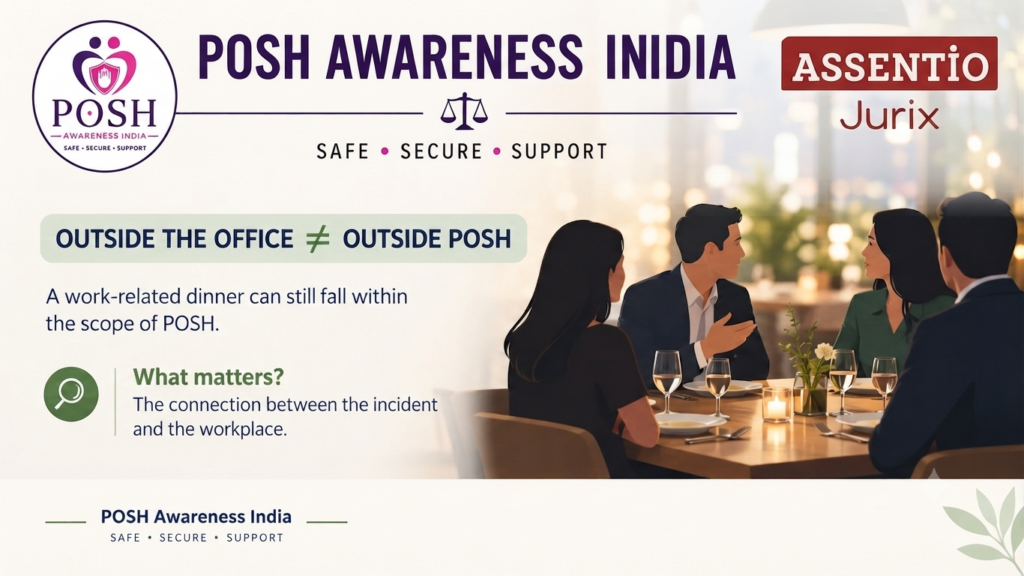
A team dinner may happen outside office hours—but that does not necessarily place it outside the scope of workplace protection.
A team dinner can seem like a purely social occasion.
But what happens when:
- A colleague makes sexually inappropriate comments;
- A manager engages in unwanted physical contact;
- Someone makes repeated personal or sexual remarks; or
- Inappropriate messages are sent during or after the event?
The question is:
Can POSH apply when the incident happens during a team dinner?
The Short Answer: It Can.
The POSH Act, 2013 gives the term “workplace” a broad meaning. It is not restricted to the four walls of an office.
Section 2(o) includes places visited by an employee arising out of or during the course of employment. Therefore, depending on the circumstances, work-related events outside the office may fall within the scope of the workplace.
The important question is not simply where the incident happened, but also its connection with employment.
Consider This Situation
A company organises a team dinner at a restaurant after working hours.
During the dinner, a senior employee repeatedly makes inappropriate remarks towards a colleague and later attempts unwanted physical contact.
The fact that the incident occurred at a restaurant and after office hours does not, by itself, take it outside the scope of POSH.
The nature of the event, the relationship between the parties and the connection of the gathering with employment may all be relevant.
“But It Was After Office Hours…”
That alone does not decide the issue.
Work-related interactions can continue beyond regular working hours through:
- Team dinners and celebrations;
- Off-site meetings;
- Conferences and training programmes;
- Official travel;
- Team outings; and
- Other work-related events.
A change in time or location does not automatically end the professional connection.
At the same time, not every social interaction between colleagues will automatically fall under POSH. The facts and circumstances must be examined.
What Should the Internal Committee Consider?
If a complaint arises from a team dinner, the IC may consider:
- Was the dinner organised, sponsored or facilitated by the organisation?
- Was attendance connected with work?
- What exactly happened?
- What was the relationship between the parties?
- Was the alleged conduct unwelcome and of a sexual nature?
- Were there witnesses or relevant communications?
- Are there photographs, messages or other supporting material?
- What were the surrounding circumstances?
The IC should assess the complete factual context rather than applying a blanket rule that every team dinner is—or is not—a workplace.
A Social Setting Does Not Automatically Remove Professional Boundaries
A workplace event may be informal, but that does not mean professional boundaries disappear.
A personal comment may become unwelcome.
A joke may cross a professional boundary.
Physical contact may become inappropriate.
The fact that colleagues are socialising does not by itself establish consent to personal or sexual behaviour.
At the same time, not every joke, conversation or interaction at a team dinner constitutes sexual harassment.
The conduct must be assessed in light of the applicable legal framework and the circumstances of the particular case.
The Key Takeaway
POSH is not limited to desks, cabins and office premises.
Work-related activities can take place in many settings.
So, when an incident occurs during a team dinner, the right question is not simply:
“Were we in the office?”
It is:
“What was the connection between the event, the conduct and the workplace?”
That distinction can matter.
Work may move outside the office. Professional boundaries should not.
POSH Awareness India
SAFE . SECURE . SUPPORT
Legal Note: This article is intended for general awareness and educational purposes only and should not be considered legal advice. The applicability of the POSH Act, 2013 depends on the facts and circumstances of each case.