
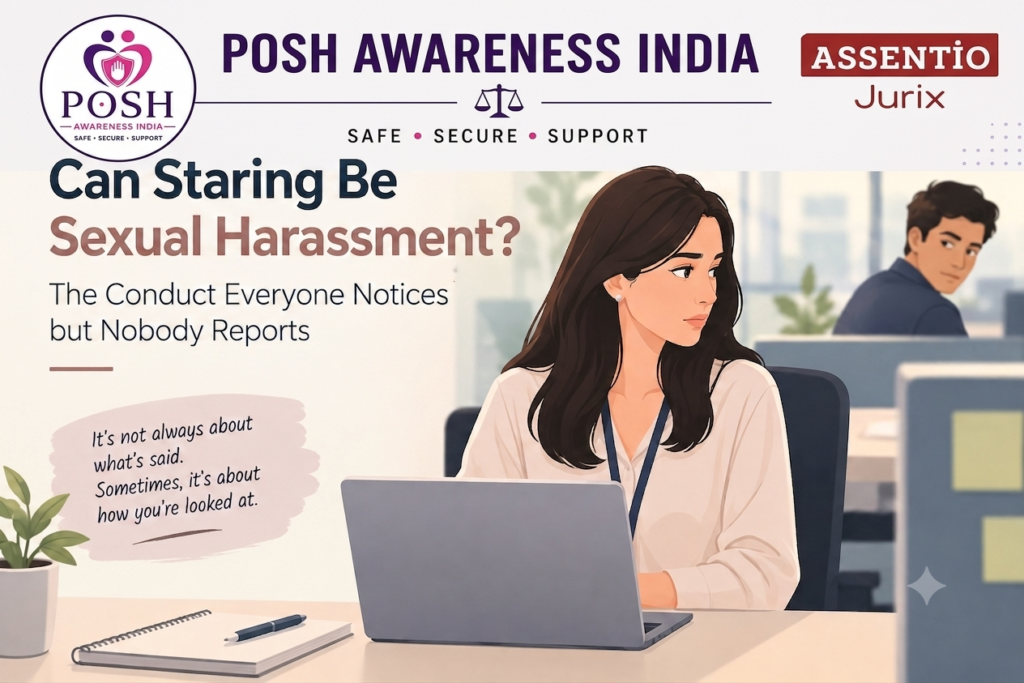
The Conduct Everyone Notices but Nobody Reports
She never said, “Stop.”
He never touched her.
He never sent an inappropriate message.
But every time she entered the room, he stared.
At first, she ignored it.
Then she began noticing it during meetings, in the cafeteria and even while walking through the office.
She felt uncomfortable — but wondered whether something as seemingly simple as staring could actually become a POSH concern.
So, Can It Be?
It can, depending on the nature and circumstances of the conduct. But not every instance of staring amounts to sexual harassment.
Section 2(n) of the POSH Act defines sexual harassment to include unwelcome physical, verbal or non-verbal conduct of a sexual nature.
That means the fact that there was no touching, message or verbal remark does not automatically take conduct outside the POSH framework.
The more important question is:
What was the nature of the conduct, and was it unwelcome and sexual in nature?
A brief look during a conversation is ordinary workplace interaction.
But repeatedly staring at someone’s body, watching someone in a sexualised manner, or engaging in persistent conduct that is unwelcome may raise a very different concern.
The surrounding circumstances matter.
When Can Staring Become a POSH Concern?
An Internal Committee should not treat “staring” as automatically constituting sexual harassment.
Instead, the Committee may need to examine factors such as:
- Was the conduct isolated or repeated?
- Was the staring directed at the person’s body or otherwise sexualised in nature?
- Was the conduct unwelcome?
- Was there a pattern of similar behaviour?
- Were there relevant witnesses or surrounding circumstances?
- Is there any supporting communication, CCTV footage or other available evidence?
- What was the context in which the conduct occurred?
Importantly, an express verbal objection is not necessarily the only way to establish that conduct was unwelcome. The complete circumstances should be considered.
At the same time, discomfort alone does not automatically establish that sexual harassment has occurred. The allegation must be examined fairly, with the versions of both the complainant and respondent considered along with the available evidence and circumstances.
What If There Is No Recording?
This is one reason non-verbal conduct can be difficult to report.
There may be:
- no message,
- no photograph,
- no recording,
- no written communication.
That does not automatically mean that the allegation has no basis.
At the same time, the absence of direct evidence does not mean that the allegation is automatically established.
An Internal Committee may consider the available evidence, witness accounts, surrounding circumstances and the consistency of the versions presented before reaching its findings.
Why Do People Often Ignore It?
Because staring can appear too insignificant to report.
Employees may think:
“He didn’t say anything.”
“He didn’t touch me.”
“Maybe I’m overthinking it.”
But workplace concerns do not always begin with an obvious verbal statement or physical act.
Recognising potentially inappropriate non-verbal conduct can help employees understand when a pattern of behaviour is making them uncomfortable and when it may be appropriate to raise a concern.
The Important Distinction
There is a difference between:
Looking at someone and repeatedly watching someone in a sexualised or unwelcome manner.
There is also a difference between:
A momentary glance and a repeated pattern of conduct that makes a person feel watched or objectified.
The POSH framework does not require every ordinary workplace interaction to be treated as sexual harassment. But the absence of touching or words does not, by itself, mean that non-verbal conduct can never fall within the statutory framework.
The Takeaway
Not every look is harassment.
But repeated, unwelcome and sexualised staring should not automatically be dismissed as “just looking.”
The POSH Act recognises that sexual harassment may involve non-verbal conduct of a sexual nature. Whether particular conduct falls within that framework depends on the facts, the nature of the behaviour and the surrounding circumstances.
Sometimes, the conduct everyone notices is the conduct nobody reports.
Legal Note
This article is intended for general awareness and educational purposes only and does not constitute legal advice. The applicability of the POSH Act to any particular conduct depends on the facts and circumstances of each case.