
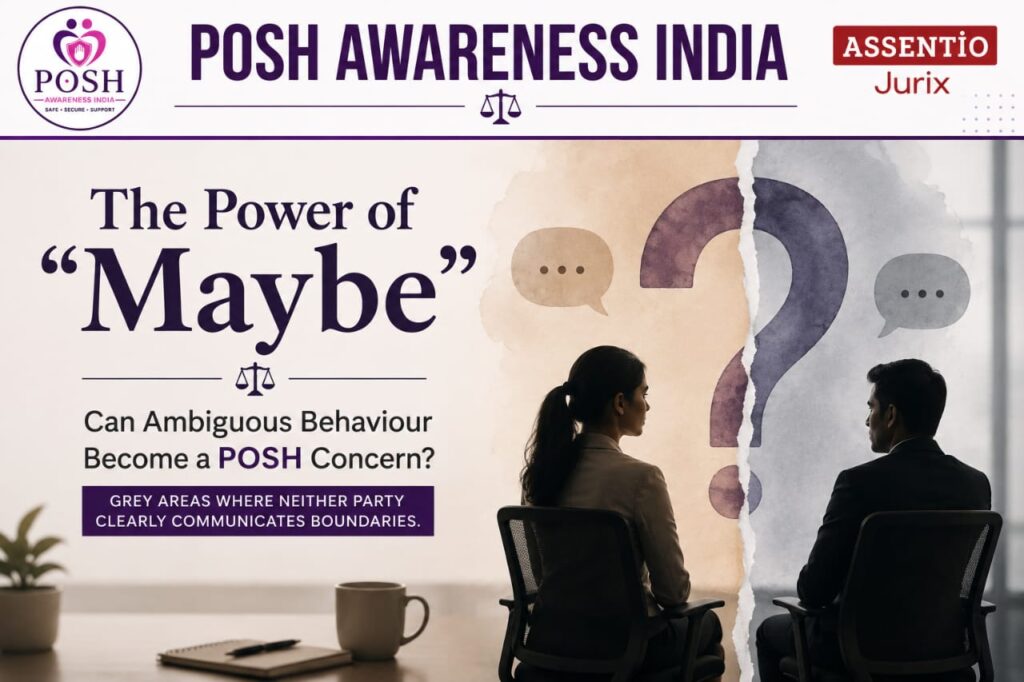
Understanding the grey areas where workplace boundaries are not clearly communicated
INTRODUCTION
Workplace interactions are not always black and white.
Sometimes there is no clear “yes” or “no”—only hesitation, silence, mixed signals or behaviour that may be interpreted differently by the people involved.
This raises an important question:
Can ambiguous behaviour become a POSH concern?
The answer depends on the nature of the conduct, whether it was unwelcome, the circumstances in which it occurred, and whether it falls within the statutory framework of workplace sexual harassment.
1. NOT EVERY AWKWARD INTERACTION IS SEXUAL HARASSMENT
An uncomfortable or awkward interaction does not automatically amount to sexual harassment.
The conduct must be examined in its context, nature and circumstances, rather than being judged solely on the basis of one isolated interaction.
A misunderstanding, social awkwardness or unsuccessful personal interaction should not automatically be labelled as a POSH violation.
2. THE GREY AREA OF “MAYBE”
Consider situations such as:
- A colleague repeatedly asks another colleague to meet outside work.
- Personal compliments gradually become more intimate.
- Someone continues sending personal messages despite limited or non-responsive communication.
- A colleague makes suggestive jokes but later claims they were “only joking.”
- An employee is unsure whether another person’s attention is friendly or unwelcome.
None of these situations should automatically be labelled as sexual harassment.
However, the pattern of behaviour, the nature of the communication and the surrounding circumstances may become relevant when assessing a complaint.
3. SILENCE IS NOT NECESSARILY CONSENT
One of the most misunderstood aspects of workplace interaction is silence.
A person may remain silent because they are:
- Uncomfortable;
- Unsure how to respond;
- Afraid of offending someone;
- Concerned about workplace consequences; or
- Dealing with a power imbalance.
Therefore, silence should not, by itself, be treated as affirmative consent or as conclusive evidence that the conduct was welcome.
At the same time, the Internal Committee should assess the complete circumstances rather than drawing an automatic conclusion from silence alone.
4. CONTEXT CAN CHANGE THE MEANING
The same words or behaviour can have different implications depending on the circumstances.
For example, a compliment between colleagues may be harmless in one situation but may become relevant in a POSH inquiry when it is:
- Repeated despite indications of discomfort;
- Accompanied by unwelcome sexual advances;
- Coming from someone in a position of authority;
- Followed by inappropriate or sexually suggestive messages; or
- Connected with promises, threats or other workplace-related consequences.
Context matters.
An isolated statement cannot always be assessed in the same way as a continuing pattern of conduct.
5. POWER DYNAMICS MAKE “MAYBE” MORE COMPLICATED
When an interaction involves a manager, senior employee or someone who has influence over another person’s career, the situation can become more complex.
An employee may not feel comfortable expressing a direct “no” because of concerns about:
- Performance evaluations;
- Promotions;
- Work allocation;
- Career opportunities; or
- Workplace relationships.
This is why organisations should consider not only what was said or done, but also the relationship between the individuals and the surrounding circumstances.
6. INTENT IS NOT THE ONLY QUESTION
A person may say:
“I didn’t mean anything by it.”
However, the assessment should not necessarily stop at the person’s stated intention.
The Internal Committee should consider the nature of the conduct, whether it was unwelcome, the surrounding circumstances, the relationship between the parties, the available evidence and the applicable legal framework.
A person’s stated intention may be relevant, but it should be assessed alongside the other circumstances of the case.
7. THE ROLE OF THE INTERNAL COMMITTEE
When an allegation involving ambiguous behaviour is made, the Internal Committee should avoid jumping to conclusions.
Instead, it should objectively consider questions such as:
- What exactly happened?
- What conduct has been alleged?
- Was the conduct unwelcome?
- Was the conduct sexual in nature?
- Was there a pattern of behaviour?
- What was the relationship between the parties?
- Was there a power imbalance?
- What evidence is available?
- What do the surrounding circumstances indicate?
The objective is not to assume either guilt or innocence at the outset, but to assess the complaint fairly, impartially and in accordance with the applicable legal framework.
KEY TAKEAWAY
POSH is not about turning every awkward interaction into a complaint.