
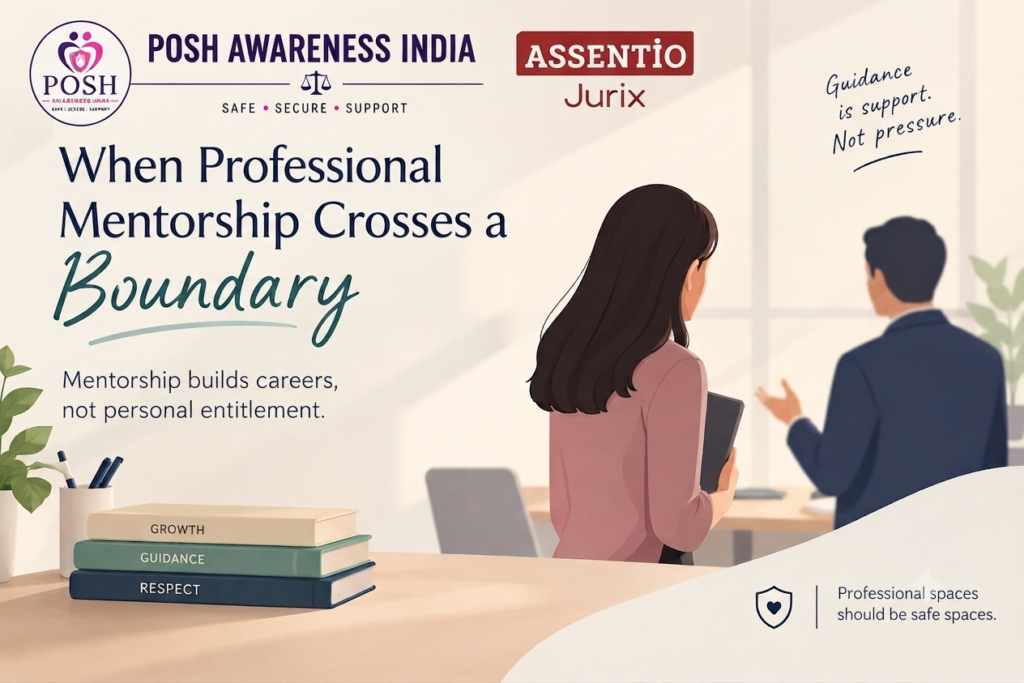
When professional guidance becomes something more
Mentorship is meant to support professional growth—sharing knowledge, giving guidance and helping someone build their career.
But what happens when a professional mentoring relationship begins to involve conduct that is unwelcome and sexual in nature?
Where Can the Boundary Blur?
A mentor may have regular one-to-one access to a mentee through meetings, calls, messages or career discussions.
The relationship may become a POSH concern where the conduct involves, for example:
- unwelcome personal or intimate conversations;
- sexually coloured remarks or comments about appearance;
- unwelcome sexual or romantic messages;
- unwanted physical contact;
- requests or advances of a sexual nature; or
- using professional authority or influence in connection with sexual attention or favours.
The fact that the person is a mentor does not place the conduct outside the POSH framework.
Section 2(n) covers unwelcome physical, verbal or non-verbal conduct of a sexual nature. India Code
Does Every Uncomfortable Interaction Become POSH?
No.
Being uncomfortable is not, by itself, the statutory test.
The IC must examine the nature of the conduct, whether it was unwelcome, whether it was sexual in nature, and the surrounding circumstances.
For example, repeated personal messages may become relevant if they contain sexual or romantic content and continue despite the recipient indicating that the communication is unwelcome.
But an ordinary career discussion, personal conversation or professional disagreement does not become sexual harassment merely because it feels uncomfortable.
What About Power and Influence?
Mentorship can involve an element of professional influence.
That does not mean every interaction between a mentor and mentee is a POSH issue.
However, where professional influence is used in connection with conduct covered by the POSH Act—for example, a demand or request for sexual favours, or an implied promise or threat connected with employment—the power relationship may become particularly relevant. Section 3(2) specifically recognises circumstances involving preferential treatment, detrimental treatment and employment-related threats. IndiaCode by eCourtsIndia
What Can a Mentee Do?
Where the conduct raises a genuine POSH concern, relevant messages, emails and other records should be preserved.
The employee may use the organisation’s POSH mechanism where the alleged conduct falls within the Act.
The IC should then examine the allegations and evidence fairly rather than assuming that the existence of a mentoring relationship either proves or disproves the complaint.
THE KEY POINT
Mentorship creates professional trust—not personal entitlement.
A mentor can guide someone’s career.
But professional access or influence does not create a right to cross personal or sexual boundaries.
KEY TAKEAWAY
A mentoring relationship does not automatically create a POSH issue.
But where professional interaction involves unwelcome conduct of a sexual nature, the relationship may become relevant to a POSH inquiry.
Disclaimer: This article is for general legal awareness and educational purposes and should not be treated as case-specific legal advice.