
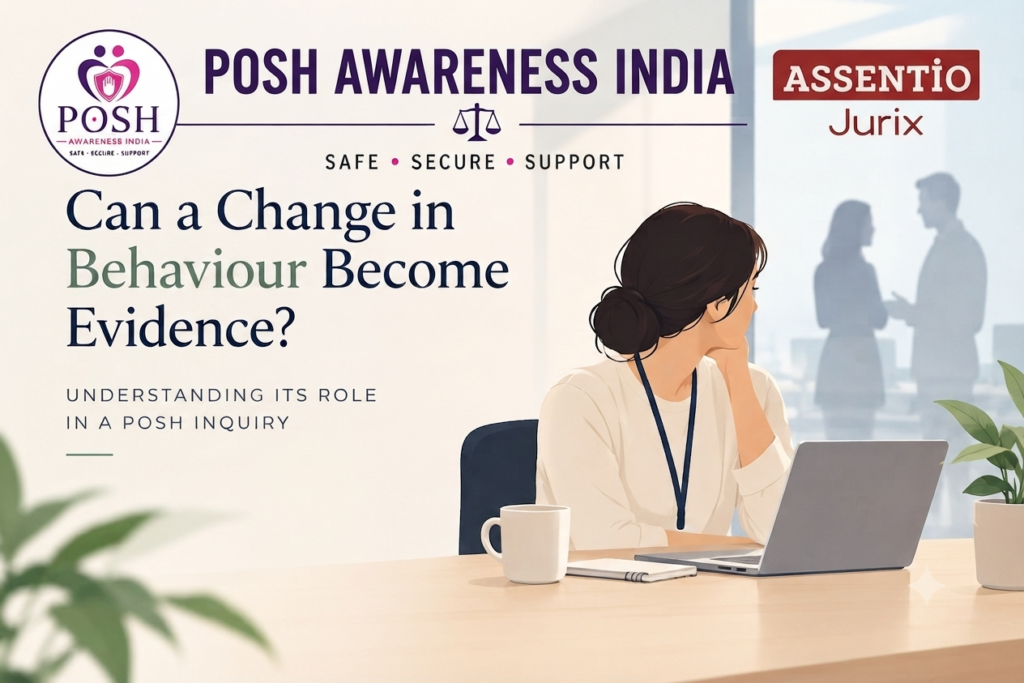
An employee who was once confident suddenly becomes withdrawn.
They stop interacting with a particular colleague, avoid certain meetings, or appear unusually uncomfortable at work.
But can such a change in behaviour become relevant in a POSH inquiry?
Behaviour Can Be Relevant
In a POSH inquiry, the IC may have to consider more than one piece of evidence.
A change in behaviour may become relevant circumstantial material when it connects with the allegations and surrounding facts.
For example:
- an employee suddenly starts avoiding the respondent;
- communication between them changes after an alleged incident;
- the complainant begins avoiding a particular workplace area;
- colleagues notice a significant change in interactions; or
- the change occurs around the period of the alleged incident.
Such circumstances may help the IC assess the overall sequence of events.
But Is Behavioural Change Proof?
Not by itself.
A person may become withdrawn, stressed or uncomfortable for many reasons unrelated to sexual harassment.
Therefore, an IC should not treat a behavioural change as automatic confirmation of an allegation.
Instead, it may consider:
What changed?
When did it change?
What happened around that time?
Did anyone independently observe the change?
Is there other material supporting the allegation?
The Bigger Picture Matters
A POSH inquiry may involve statements, communications, timelines, witness accounts and other relevant circumstances.
A behavioural change can therefore be one part of the overall evidentiary picture.
Its significance will depend on its connection with the allegations and the other material before the IC.
KEY TAKEAWAY
A change in behaviour can be relevant.
A change in behaviour is not automatically proof of harassment.
The IC must assess its significance along with the other material and should not assume that there is one “correct” way a person must behave after an alleged incident.Disclaimer: This article is for general legal awareness and educational purposes and should not be treated as case-specific legal advice
Disclaimer: This article is for general legal awareness and educational purposes and should not be treated as case-specific legal advice