
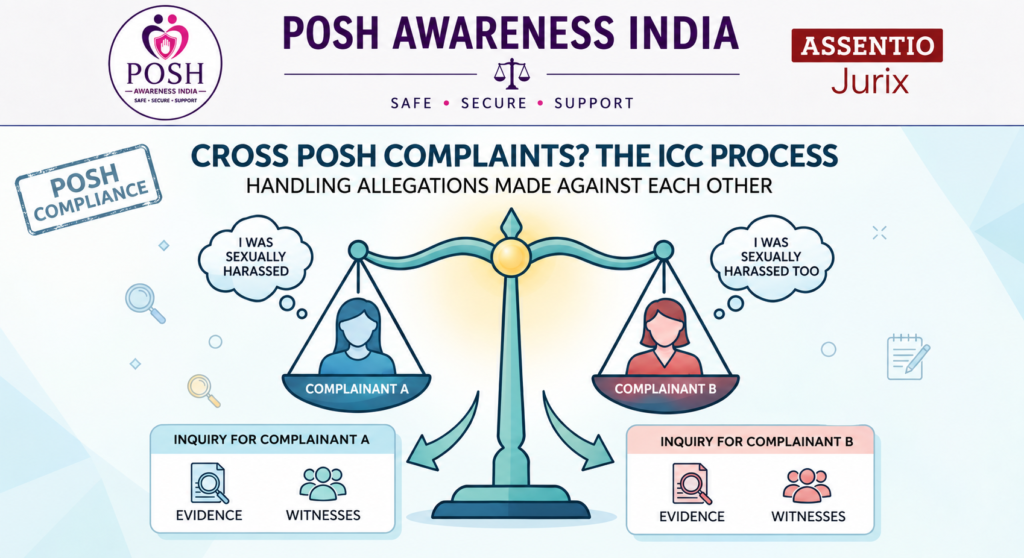
When allegations are made from both sides
One complaint says:
“I was sexually harassed.”
The other says:
“I was sexually harassed too.”
So, what does the Internal Committee do now?
When two people make allegations against each other, it may be tempting to assume that one complaint is genuine and the other is simply a counterblast.
But the IC should not begin with that assumption.
The real question is:
What does the evidence show about each allegation?
Two Complaints Do Not Automatically Cancel Each Other Out
If the complaints fall within the POSH framework, each allegation must be examined on its own merits.
The fact that one complaint was filed first does not automatically make it genuine.
Similarly, a complaint filed later does not automatically make it false or malicious.
Timing may be relevant, but timing alone is not proof of intent.
The IC should focus on the actual allegations, the evidence and the circumstances surrounding them.
What If Both Complaints Arise From the Same Incident?
Imagine two employees attend a team dinner.
Later, one alleges:
“There was an unwelcome sexual comment.”
The other alleges:
“There was inappropriate physical conduct and an unwelcome remark.”
Both complaints may arise from the same evening.
The IC may therefore examine:
- messages or emails;
- CCTV footage, where available;
- witness accounts;
- the sequence of events;
- contemporaneous communications; and
- other relevant evidence.
The important point is to separate the allegations.
One complaint should not automatically determine the outcome of the other.
What About a “Counterblast”?
A respondent may argue that the second complaint was filed only as retaliation.
That allegation itself must be examined.
Under Section 14 of the POSH Act, inability to substantiate a complaint or provide adequate proof does not automatically make the complaint false. Malicious intent is a separate issue that must be established after inquiry.
Therefore:
Not proved ≠ automatically false
And:
Filed later ≠ automatically malicious
Can Both Complaints Be Established?
If both complaints independently fall within the POSH framework, there is no rule requiring the IC to treat the matter as a choice between one “genuine” complainant and one “false” complainant.
Depending on the evidence, findings may be made separately on the allegations in each complaint.
One may be established while the other is not.
Both may be established.
Or neither may be established.
The inquiry is about allegations and evidence—not about choosing a winner and a loser.
What Should the IC Keep in Mind?
When allegations are made against each other, the IC should ask:
What exactly has each person alleged?
Does each allegation fall within the POSH framework?
What evidence supports or contradicts each allegation?
Is either complaint alleged to be malicious, and is there evidence to establish that?
Have the parties received a fair opportunity to present their case?
The IC should avoid assuming that:
- the first complaint is automatically genuine;
- the second complaint is automatically retaliatory; or
- an unproved allegation is automatically a false complaint.
The Bigger Lesson
A POSH inquiry is not a contest between two employees.
Where complaints fall within the POSH framework, each allegation deserves a fair and independent examination.
Do not decide based on who complained first.
Do not assume retaliation.
Do not assume guilt.
Examine the allegations. Examine the evidence. Follow due process.
KEY TAKEAWAY
Two complaints do not automatically mean two false complaints.
And they do not require the IC to choose a side.
The task is to determine what the evidence establishes about each allegation.
Disclaimer: This article is for general legal awareness and educational purposes and should not be treated as case-specific legal advice.