
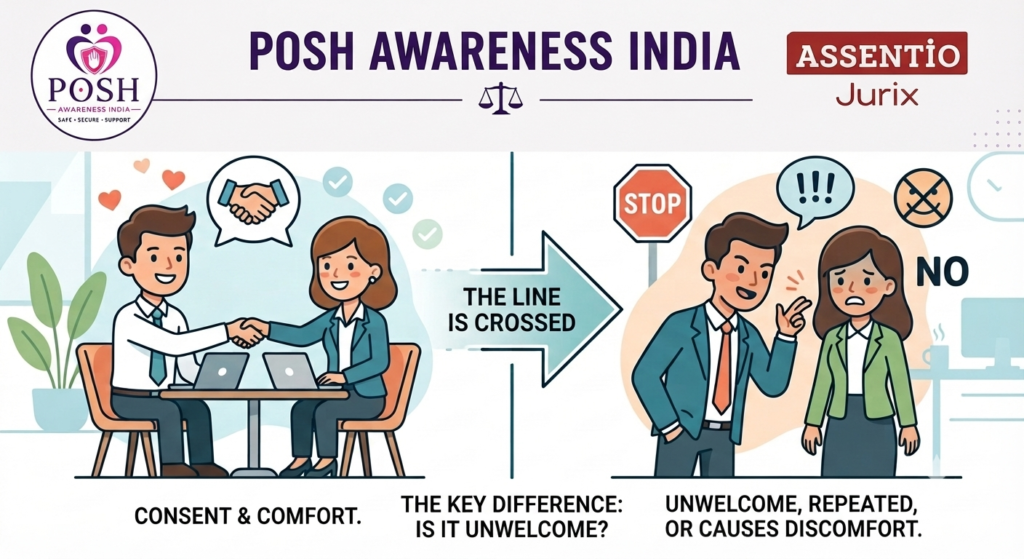
When friendly interaction crosses a professional boundary
A compliment.
A playful message.
A little teasing between colleagues.
Not every friendly or flirtatious interaction at work automatically amounts to sexual harassment.
But what happens when the behaviour becomes unwelcome, sexual in nature, or continues despite the other person’s objection?
That is where the situation can become a POSH concern.
Flirting Is Not Automatically Sexual Harassment
“Flirting” is not, by itself, a category under the POSH Act.
The law focuses on the nature of the conduct and whether it is unwelcome and sexual in nature. Section 2(n) includes sexually coloured remarks and other unwelcome physical, verbal or non-verbal conduct of a sexual nature.
So the important question is not:
“Was the person flirting?”
It is:
“What exactly was said or done, and was the conduct unwelcome and sexual in nature?”
A light compliment between colleagues may remain an ordinary workplace interaction.
But repeated sexual comments, unwanted advances or sexually suggestive messages may raise a very different concern.
When Can Flirting Become a POSH Concern?
Depending on the circumstances, conduct described as “flirting” may become relevant when it involves:
- repeated romantic or sexual comments after they are unwelcome;
- sexually suggestive messages or jokes;
- unwanted romantic or sexual advances;
- comments about someone’s body with sexual undertones;
- sending sexually inappropriate images or messages; or
- using professional authority or influence to pressure someone for personal or sexual attention.
The actual conduct matters more than the label attached to it.
“But They Were Flirting Back…”
This is where assumptions can become misleading.
A person may initially respond positively to a conversation and later decide that the interaction is no longer welcome.
Previous friendliness or participation in a conversation does not automatically mean that every subsequent interaction is welcome.
The circumstances at the time of the alleged conduct must be considered.
What Should the Internal Committee Look At?
If a complaint describes certain behaviour as “flirting,” the Internal Committee should focus on the underlying facts.
Depending on the case, it may consider:
- What exactly was said or done?
- Was the conduct welcome or unwelcome?
- Was it sexual in nature?
- Was there a pattern of similar behaviour?
- Was there a relevant power or workplace relationship?
- What happened after the person indicated that the conduct was unwelcome?
- Are there messages, emails, witnesses or other relevant evidence?
The IC should not decide a complaint merely by applying the label “flirting.”
It should assess the conduct, evidence and surrounding circumstances fairly.
The Workplace Lesson
Being friendly is not an invitation.
At the same time, not every compliment, joke or personal conversation is sexual harassment.
The important distinction is between an ordinary workplace interaction and unwelcome conduct of a sexual nature falling within the POSH framework.
Professional boundaries do not disappear simply because two colleagues have a friendly relationship.
And when someone clearly communicates that sexual or romantic attention is unwelcome, continuing that conduct may create a very different situation.
The Takeaway
Flirting is not automatically harassment.
But calling something “just flirting” does not take it outside the POSH framework if the underlying conduct is unwelcome and sexual in nature.
The real question is not:
“Was it flirting?”
It is:
“What was the conduct, was it welcome, and does it fall within the statutory framework of sexual harassment?”Legal Note:This article is intended for general awareness and educational purposes only and should not be considered legal advice. The applicability of the POSH Act, 2013 depends on the facts and circumstances of each case.