
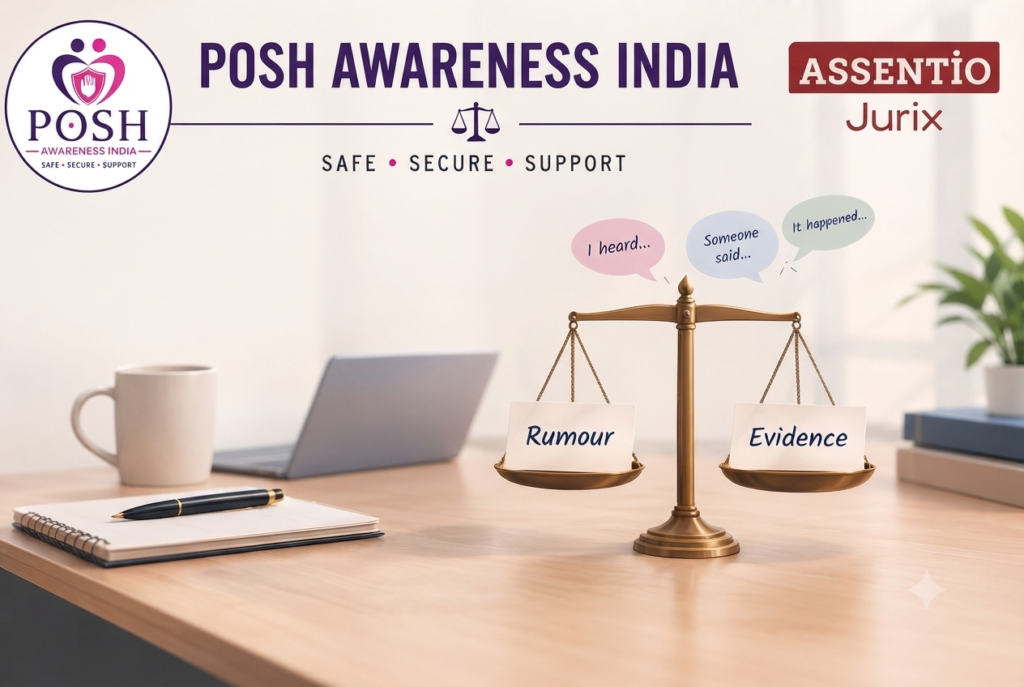
When “everyone is saying it” is not the same as knowing what actually happened
A rumour starts spreading across the office.
“Something happened between them.”
A few employees say they heard the same story. But nobody actually witnessed the alleged incident.
So the question is:
Can workplace rumours become relevant in a POSH inquiry?
A Rumour Is Not Proof
An Internal Committee (IC) has to examine the complaint and the material relevant to the allegations.
A statement such as:
“I heard that he behaved inappropriately with her.”
does not, by itself, establish that the alleged conduct actually occurred.
But that does not necessarily mean the information has no relevance.
The IC should understand what the witness personally knows, what they were told by someone else, and what they merely heard through workplace discussions.
First-Hand Information vs. Hearsay vs. Rumour
Consider the difference:
First-hand information:
“I was present when he made the comment.”
Hearsay:
“She told me that he made the comment.”
Workplace rumour:
“I heard from someone that he made the comment.”
These are different forms of information.
The IC should identify how the information came to the witness and assess its relevance and reliability rather than treating every version as equivalent.
Can Hearsay or Rumour Ever Be Relevant?
Yes, depending on the circumstances.
For example, an employee may not have witnessed the alleged incident but may have spoken to the complainant immediately afterwards.
That conversation may be relevant to understanding the surrounding circumstances.
Similarly, information circulating in the workplace may sometimes lead the IC to material that can be independently examined—for example, emails, messages, witnesses or other records.
However, the fact that several people have heard the same story does not automatically make the underlying allegation true.
The source and basis of the information still matter.
Courts have recognised that internal disciplinary inquiries are not conducted on exactly the same evidentiary footing as criminal trials, and credible circumstantial or hearsay material may be considered where it has a reasonable connection with the matter.
The “Everyone Knows” Problem
One of the most dangerous statements in a workplace inquiry is:
“Everyone in the office knows about it.”
The number of people repeating a story does not, by itself, establish its truth.
A story can become widely circulated without anyone having direct knowledge of what actually happened.
Therefore, the IC should look beyond how many people heard the story and examine:
- Where did the information originate?
- Who personally witnessed or heard anything?
- When did the witness first learn about it?
- Is there supporting material?
- Are different accounts consistent?
- What fact does the information actually establish?
What If a Rumour Leads to Evidence?
This is where the distinction becomes important.
Suppose an employee hears that inappropriate messages were allegedly exchanged.
The employee did not see those messages.
During the inquiry, however, relevant chat records are produced by one of the parties.
The rumour itself may have limited value.
But the actual chat records can be independently examined as part of the inquiry.
Therefore, information circulating in the workplace may sometimes become a starting point for identifying relevant material—but it should not become a substitute for examining that material.
What Should the IC Do?
The Internal Committee should neither automatically accept nor automatically dismiss information merely because it originated as a rumour.
It should assess:
- The source of the information;
- Whether the witness has first-hand knowledge;
- The timing of the information;
- Its consistency with other material;
- Any supporting documentary or digital evidence;
- The surrounding circumstances; and
- Its actual relevance to the allegations.
The ultimate assessment should be based on the material considered during the inquiry, not simply on workplace gossip.
The Takeaway
A workplace rumour may raise a question, but repeated gossip does not automatically establish an allegation.
The IC’s role is not to decide based on:
“What is everyone saying?”
It is to examine:
“What does the available material actually establish?”
A fair inquiry distinguishes between what a person personally knows, what they were told, and what they merely heard from others.
In a POSH inquiry, a rumour may open the door to a question—but evidence and circumstances must help answer it.
Legal Note:This article is intended for general awareness and educational purposes only and should not be considered legal advice. The applicability of the POSH Act, 2013 and the assessment of evidence depend on the facts and circumstances of each case.